Space exploration has quickly emerged as one of the fastest growing industries in the world. That’s why I am calling the space exploration industry as my #1 growth sector for 2026. I want to make sure my wealth management clients and follower know about the opportunity. For investors looking for growth – space is a good place to be investing. In this report I am going to outline the growth of the global space industry, share my #1 space stock for 2026 and four additional space stocks that I believe have major growth potential.
The global space race is being privatized: In the old days the U.S. government and other powerful governments around the world were leading the charge in space exploration. In the last ten years we have seen a big shift – the space exploration industry is becoming privatized. That transition has been visible with a growing list of famous billionaires launching private space exploration companies. That includes Elon Musk with SpaceX, Jeff Bezos with Blue Origin and Richard Branson with Virgin Galactic.

*image from businessinsider.com

The reason the space industry is going private is simple – profit opportunity. There is significant demand from the private sector for more rockets to haul high-tech equipment into space, operate in space and collect data from space. This is why the most respected market-research firms are predicting the space exploration industry will experience significant growth in the next ten years.
Leading market-research firm McKinsey & Company recently published a report on the space industry – predicting tremendous growth in the next ten years. Here are some more details.
The space industry is approaching the next frontier, with each week bringing news of a major development somewhere in the world. Be it a test of a new rocket system, the launch of an innovative satellite, or a robotic exploration mission safely landing on the moon, activity in space is accelerating.

As you can see – the long term outlook for the space industry looks good. The global space industry is in position for major growth in the next 5-10 years. I expect that strong industry growth to drive space stocks higher in the next few years.
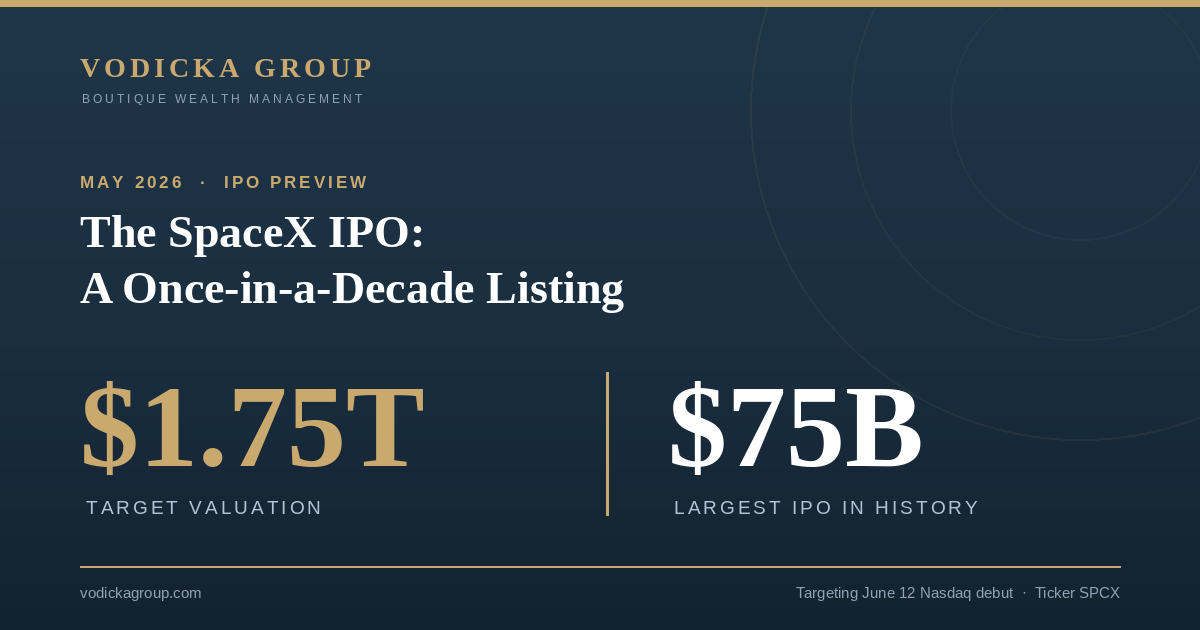
In the short run, I also see a powerful catalyst that i expect to give space stocks a major boost in 2026 – The SpaceX IPO. This is already projected to be the largest IPO in the history of the US stock market and enthusiasm is running red hot. I expect enthusiasm for the SpaceX IPO to drive heavy interest in the broader space stock sector and the early industry leaders that I am profiling below.
On that note – below I share my #1 space stock for 2026 and four additional space stocks that I like.
Rocket Lab is an early industry leader in the high-growth space exploration industry. The company was founded in 2006 and is headquartered in Long Beach, California. Rocket Lab went public in early 2020 and its shares are currently traded on the NASDAQ stock exchange. Rocket Lab stands out because of its impressive portfolio of revenue producing rockets and space systems. Below I am going to highlight a few factors that have distinguished Rocket Lab from the competition and why I am bullish on this stock.
Industry leading portfolio of space products and services: Rocket Lab owns one of the best and most advanced portfolios of rockets and space systems in the industry. That includes its Electron rocket, a partially reusable rocket that has launched 239 satellites into space. There is already massive demand for Electron’s service to launch more satellites into space and that’s the main reason Rocket Lab revenue is surging. Take a look at Electron in action below.

- Rocket Lab revenue for the twelve months ending June 30, 2025 was $0.504B, a 54.36% increase year-over-year.
- Rocket Lab annual revenue for 2024 was $0.436B, a 78.34% increase from 2023.
- Rocket Lab annual revenue for 2023 was $0.245B, a 15.92% increase from 2022.
- Rocket Lab annual revenue for 2022 was $0.211B, a 239.02% increase from 2021.

*chart and stats from macrotrends.com

Rocket Lab has been volatile on the chart: Rocket Lab went public in 2020 and for the first few years shares didn’t do well. However, as Rocket Lab acquired more customers and grew revenue, investors started to notice. Shares took off in the second half of 2024 and have been on a roll since. Even though RKLB is up a lot in the last 12 months I still think its early in the longer trend.
For me this is a stock to be patient with and look to add shares on pullbacks and weakness. As you can see from the chart the share price has been extremely volatile. Large pullbacks are common in RKLB. That has historically been a good time to add shares. Take a look at the 5-year chart below.

4 More Space Stocks I like for 2026
Planet Labs PBC (NYSE: PL) is a leading American Earth-imaging and data analytics company that operates the largest fleet of Earth-observation satellites in history. Founded in 2010 by former NASA scientists, the company’s core mission is to image the entire Earth’s landmass daily to make global change visible and actionable.
Blacksky Technology (NASDAQ: BKSY)
is a leading provider of real-time geospatial intelligence, operating a proprietary satellite constellation focused on high-frequency monitoring and rapid-response analytics.
Intuitive Machines (NASDAQ: LUNR)
is an American space exploration company specializing in lunar landing, infrastructure, and data services. As of January 2026, it is the only private company to have successfully achieved a soft landing on the Moon.
AST Space Mobile (NASDAQ: ASTS)
is an American satellite company that is building the first space-based cellular broadband network designed to connect directly with standard, unmodified smartphones. By partnering with mobile network operators (MNOs) like AT&T and Verizon, AST aims to eliminate connectivity dead zones globally.
3-Year chart below of these 4 stocks: These space stocks above were pretty flat for a a few years in 2022, 2023 and most of 2024. However in the last 12 months space stocks have started rebounding and accelerating. Some of these stocks are up a lot in the last 12 months but to me it looks like the longer trend is still early.