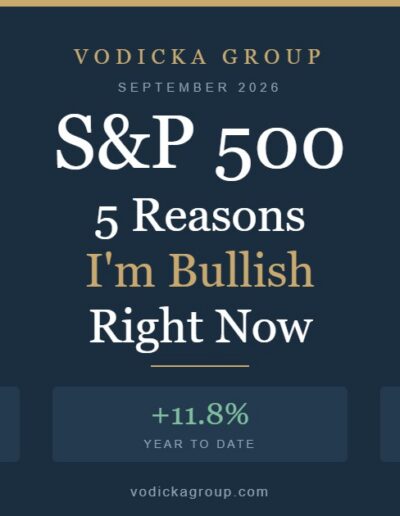
The S&P 500 (SPY) kicked off 2026 on a strong note, gaining 1.4% in January and touching a fresh all-time high on January 27th — a powerful reminder of just how resilient this market has been. Yes, February and March have brought some short-term softness, and the index is sitting around 6,699 as of March 16. But let’s keep this in perspective: we are talking about a modest pullback of roughly 3.5% from an all-time high. That is completely normal. In fact, the average intra-year S&P 500 pullback since 1980 is around 14% — and the market still finishes higher in roughly three out of every four years. A small dip after two consecutive years of double-digit gains is not a warning sign. It is a healthy pause.
The big picture story for the stock market in 2026 hasn’t changed. Corporate earnings are growing, the U.S. economy is resilient, and some of the most powerful long-term trends in history — artificial intelligence, energy innovation, and digital transformation — are accelerating right underneath us. Short-term noise is always going to be part of investing. What matters is staying focused on the fundamentals, and right now those fundamentals remain firmly in our corner.
◆
Why Is the S&P 500 Down in 2026?
There are three key factors behind the recent stock market weakness in 2026. Understanding these headwinds is the first step toward making smart investment decisions.
1. Middle East Conflict Is Pushing Oil Prices Higher. This is the biggest near-term headwind for the stock market right now. The escalation involving U.S. and Israeli strikes against Iran has sent oil prices surging more than 25% in recent weeks. Higher energy costs hit consumers at the pump, raise input costs for businesses, and stoke inflation fears that make the Federal Reserve’s job harder. Until there’s more clarity on how this situation resolves, energy prices will remain a swing factor for markets. The good news: geopolitical disruptions like this have historically been temporary — and markets tend to recover quickly once the dust settles.
2. Tariffs Are Creating Short-Term Uncertainty. The Trump administration has been active on the trade front, and that’s created some noise for investors. Markets don’t love policy unpredictability, and that’s showing up in sentiment. That said, tariff headlines tend to be louder than their actual economic impact — businesses adapt, trade flows adjust, and negotiated deals often follow initial announcements. This is something to monitor, but not something to lose sleep over.
3. Tech Stocks Have Been a Drag on the Nasdaq and S&P 500. Technology led the market higher in 2024 and 2025, and now it’s leading the way down. The Nasdaq has underperformed the broader S&P 500 so far in 2026. Investors are rotating out of high-multiple tech names after a massive three-year run. Some of this is normal profit-taking — and some of it is the market asking a legitimate question: can AI growth justify these valuations?
“A 3.5% pullback from an all-time high is not a crisis. It’s the market catching its breath before the next leg higher.”
— Michael Vodicka, Registered Investment Advisor · Highland Park, IL
−0.6%
−1.1%
−1.8%
−2.0%
−3.2%
−5.4%
−7.8%
◆
3 Reasons to Be Optimistic About the S&P 500 in 2026
Despite the recent weakness, I remain optimistic on the S&P 500 outlook for 2026. Here are three fundamental reasons why the market is positioned to move higher.
1. Corporate Earnings Growth Remains Strong. The fundamentals of Corporate America are healthy. Q4 2025 earnings came in well above expectations, with S&P 500 revenues rising 9.3% and earnings jumping 13.7% — well ahead of the 7.9% growth forecast. Companies are profitable, consumer spending remains solid, and business investment in AI infrastructure is accelerating. Earnings are the engine of stock prices over time, and that engine is running well.
2. The Federal Reserve May Cut Interest Rates in 2026. Fed Governor Christopher Waller recently called the March rate decision a “coin flip,” signaling a notable shift in tone. When the Fed cuts rates, stocks historically benefit. Lower borrowing costs reduce corporate expenses, support consumer spending, and make equities more attractive relative to bonds. One or two Fed rate cuts in 2026 could be a meaningful tailwind for the S&P 500 in the second half of the year.
3. Wall Street’s 2026 S&P 500 Price Targets Are Bullish. Every major Wall Street research firm is forecasting the S&P 500 to finish 2026 significantly higher. JP Morgan has a year-end target of 7,500, Goldman Sachs is at 7,600, Deutsche Bank at 8,000, and Oppenheimer at 8,100 — implying upside of +12% to +21% from current levels. Analysts are citing earnings growth, AI spending, expected tax cuts, and potential rate cuts. When every major firm is pointing in the same direction at these magnitudes, it’s worth paying attention.
(Mar 16)
Morgan
Sachs
Bank
heimer
◆
Stock Market Outlook: What Should Investors Expect?
So where does that leave us? The short-term headwinds are real — geopolitical conflict, trade noise, and a tech sector catching its breath. But this is not a time to panic. For investors focused on long-term wealth management, it is a time to be thoughtful.
I am not making major changes to client portfolios right now. The foundation of this market — corporate earnings, AI investment, and monetary policy direction — still looks solid for the long haul. If the Middle East situation stabilizes and the tariff picture becomes clearer, I’d expect the S&P 500 to recover and push higher in the second half of 2026. That’s been the playbook before, and there’s no reason to assume this cycle is fundamentally different.
Frequently Asked Questions
Why is the S&P 500 down in March 2026?
The S&P 500 is down in March 2026 primarily due to three factors: rising oil prices driven by Middle East conflict, short-term uncertainty from tariff policy, and rotation out of high-valuation technology stocks after a strong three-year run.
What is the S&P 500 year-to-date return in 2026?
The S&P 500 is down approximately 2.1% year-to-date as of March 16, 2026 — after gaining 1.4% in January and declining in February and March.
What are Wall Street’s S&P 500 price targets for 2026?
Major Wall Street firms have bullish 2026 year-end S&P 500 targets: JP Morgan at 7,500, Goldman Sachs at 7,600, Deutsche Bank at 8,000, and Oppenheimer at 8,100 — implying upside of 12% to 21% from current levels.
Should I be worried about stock market volatility in 2026?
A 3.5% pullback from an all-time high is well within normal historical ranges. The average intra-year S&P 500 pullback since 1980 is around 14%, and the market still finishes higher roughly three out of four years. Corporate earnings remain strong and a Fed rate cut is possible, both positive signals for stocks.
How can a financial advisor in Highland Park, IL help me navigate market volatility?
A registered investment advisor like Vodicka Group in Highland Park, IL can help you build a diversified portfolio designed to weather short-term volatility while staying on track for your long-term financial goals. Schedule a free consultation to get started.
As always, if my outlook changes, my clients and readers will be the first to know. I’ll be back with another update next week – have a great day!
Until next week,
Michael Vodicka
Founder & Lead Advisor · VODICKA GROUP, INC.
Registered Investment Advisor · Highland Park, IL · vodickagroup.com

Work With a Registered Investment Advisor in Highland Park, IL
Vodicka Group provides customized wealth management for investors in Highland Park and across Illinois. Schedule a complimentary consultation and let’s review your strategy together.
Want weekly market updates like this delivered to your inbox? Sign up for our free newsletter.
Disclaimer: This report is for entertainment purposes only. Every investor should consult with an investment advisor before making investment decisions. The Vodicka Group, Inc. is not a broker/dealer. We do not receive compensation for mentioning stocks. At various times, the clients, publishers and employees of Vodicka Group, Inc., may buy or sell the securities discussed for purposes of investment or trading.